Cat Trees and Scratching Posts (2026)
Scratching posts, cat trees and cardboard scratchers compared by height, base and surface, with what the ASPCA, AVMA and FelineVMA say about declawing.
Independently chosen. As an Amazon Associate I earn from qualifying purchases: if you buy through our links, we may earn a commission at no cost to you. How we research
Quick answer
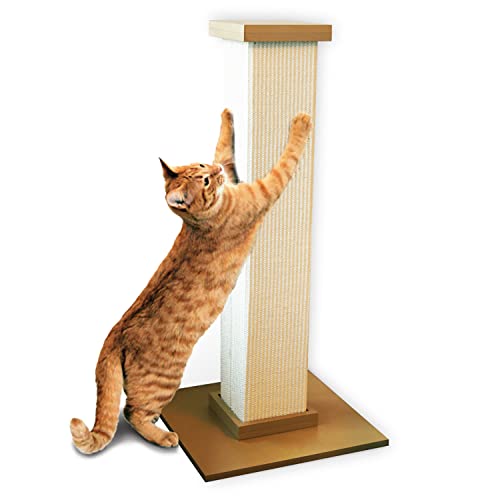
For one good scratching post, buy the SmartCat Ultimate: 32 in tall on a 16 x 16 in base, covered in woven sisal. For climbing and perching, the Feandrea 59.5 in cat tree has an anti-tip kit and is rated for cats up to 11 lb each. Add a cardboard pad such as the PetFusion Flip Pad for cats that scratch flat. The ASPCA says cats want a sturdy post tall enough to stretch fully, and it, the AVMA and the FelineVMA all oppose declawing as a fix for scratching.
Our picks
- Long cats, or a second postAmazon Basics Sturdy Cat Scratching Post, LargeFrom the listing · not tested


An indoor cat that scratches the furniture, or soon will, gets seven options here: posts, trees and pads, compared by height, base and surface. Alongside them is what the ASPCA, the AVMA and the Feline Veterinary Medical Association say about scratching and declawing.
How we chose: we did not test these; we used the listings' heights, base sizes and weight ratings, and kept only products sold by Amazon.com that were in stock on September 28, 2026.
Posts, trees and pads side by side
| Product | Type | Height | Base or size | Surface | Sold by | Amazon price |
|---|---|---|---|---|---|---|
| SmartCat Ultimate | Post | 32 in | 16 x 16 in | Woven sisal | Amazon.com | $69.99 (Amazon, as of Nov 12, 2026, 11:23 PM UTC)Check price |
| Amazon Basics Post, Large | Post | 35.4 in | 15.75 x 15.75 in | Rope (jute, per bullets) | Amazon.com | $38.37 (Amazon, as of Nov 12, 2026, 11:23 PM UTC)Check price |
| Feandrea 59.5 in | Tree | 59.5 in | 19.3 x 15.7 in | Posts, plush perches | Amazon.com | $52.99 (Amazon, as of Nov 12, 2026, 11:24 PM UTC)Check price |
| Feandrea 81.1 in | Tree | 81.1 in | Not clearly stated | 14 scratching areas | Amazon.com | $71.99 (Amazon, as of Nov 12, 2026, 11:23 PM UTC)Check price |
| Amazon Basics Tree, Large | Tree | 45.9 in | 17.7 x 17.7 in | Jute rope | Amazon.com | $54.17 (Amazon, as of Nov 12, 2026, 11:23 PM UTC)Check price |
| PetFusion Flip Pad | Flat pad | 3.2 in | 19.7 x 10.2 in | Cardboard | Amazon.com | $41.99 (Amazon, as of Nov 12, 2026, 11:23 PM UTC)Check price |
| Kitty City XL, 3-pack | Flat pads | 1.5 in | 10 x 18 in each | Cardboard | Amazon.com | $18.24 (Amazon, as of Nov 12, 2026, 11:23 PM UTC)Check price |
Prices are Amazon's, as of the time shown, and subject to change. Details
The per-cat weight limits matter more than height for trees: Feandrea rates the 59.5 in tree for cats up to 11 lb and the 81.1 in tree for cats up to 15.4 lb, and the Amazon Basics Large tree says cats under 3.5 kg. Weigh your cat before you pick one.
Why cats scratch, and why a post beats a scolding
The ASPCA's page on destructive scratching gives the reasons: cats "scratch during play. They scratch while stretching. They scratch to mark territory or as a threatening signal" to other cats. And "because cats' claws need regular sharpening, cats scratch on things to remove frayed, worn outer claws and expose new, sharper claws."
The Feline Veterinary Medical Association (FelineVMA, formerly the American Association of Feline Practitioners) puts it in one line in its declawing position statement: "Scratching is a normal feline behavior–both inherited and learned." You cannot train it out of a cat. You can give it somewhere better to go.

What makes a good scratching post
The ASPCA's advice comes down to three things.
Height. "Most cats also like a post that's tall enough that they can stretch fully." The SmartCat is 32 in and the Amazon Basics Large post is 35.4 in. Measure your cat stretched out on its hind legs before you buy a short one.
Stability. "All cats want a sturdy post that won't shift or collapse when used." A post that tips once may never be used again. This is where base size tells you something: SmartCat says its 16 x 16 in base "eliminates tipping and wobbling," and Amazon Basics uses a wood base of 15.75 in square. For trees, both Feandreas come with an anti-tip kit; install it.
Surface. The ASPCA suggests trying "cardboard, carpeting, wood, sisal and upholstery" to learn what your cat likes. The main choices on the market:
- Sisal fabric (woven sisal, as on the SmartCat) is a flat woven covering. SmartCat says it is "superior to carpeted posts that may snag nail."
- Sisal or jute rope wrapped around a post (Amazon Basics, most cat trees) is the most common surface.
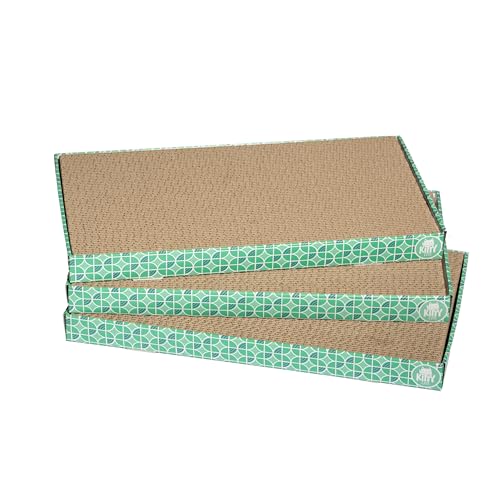
- Corrugated cardboard (PetFusion, Kitty City) is soft, cheap and meant to be used up. Most pads are flat or slanted, and both of these flip over when one side wears out.
- Carpet covers the perches on most cat trees. The ASPCA lists carpeting among the surfaces worth trying.

Vertical, horizontal, or both?
"Some cats prefer horizontal posts. Others might like vertical posts or slanted posts," the ASPCA says. Watch where your cat scratches now.
A cat that shreds the side of the sofa wants a tall vertical post. A cat that digs at the rug or the stair carpet wants something flat on the floor, such as the PetFusion Flip Pad or a Kitty City pad. Many cats use both, which is why a post plus a pad is a sensible start.
Where to put the post, and how to get it used
Place is half the battle. The ASPCA says to put scratching posts next to the things your cat already scratches, "as 'legal' alternatives," and to make those spots less appealing with "plastic, double-sided sticky tape, sandpaper or upside-down vinyl carpet runner (knobby parts up)." It also suggests scenting new posts with catnip and hanging toys on them.
Both cardboard scratchers here come with catnip, and the Amazon Basics post comes with a dangle toy. For play you run yourself, our interactive cat toy guide covers wand toys, kickers and puzzle feeders. Put a post by each piece of furniture your cat targets. If you have more than one cat, give each a spot.
Cat trees: climbing, perching and a scratching post in one
A cat tree adds height, hiding places and a view, and each post on it is a scratching surface. The trade-off is size and stability.
- The Feandrea 59.5 in has two perches and two caves on a 19.3 x 15.7 in footprint, with an anti-tip kit, for up to five cats of up to 11 lb each.
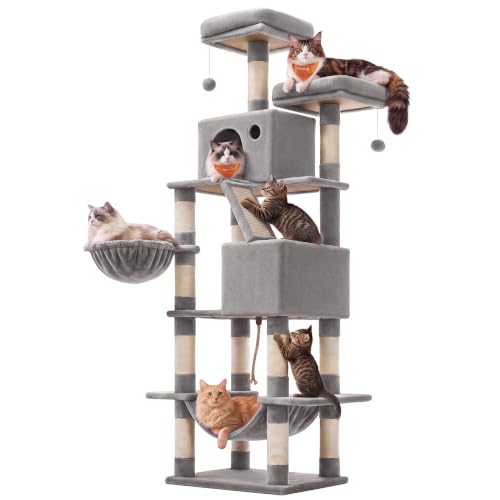
- The Feandrea 81.1 in has five levels 12 to 16 in apart, per Feandrea, 14 scratching areas and a hammock, and is rated for cats up to 15.4 lb each.
- The Amazon Basics Large is 45.9 in tall with seven rope posts, but the listing says it suits cats under 3.5 kg, so it is a kitten or small-cat tree.
If your cat is over those weight limits, a tall single post such as the SmartCat, plus a window perch, may serve it better than a tree it outgrows. A cat that climbs can reach shelves and sills, so check any plants up there against our pet-safe plants guide, which covers the ASPCA's toxic list.
Related: for a new kitten's full shopping list, see our new kitten checklist.

Declawing is not a scratching fix
All three bodies we checked oppose declawing as a way to deal with scratching.
- The ASPCA says it "is strongly opposed to declawing cats," and that declawing "should never be used as a behavioral remedy or as a preventative measure."
- The FelineVMA "strongly opposes declawing (onychectomy) as an elective procedure," and says "declawing is an amputation of the third phalanx (P3)," the last bone of each toe.
- The AVMA's policy on declawing "strongly discourages" it when not medically necessary, and says amputating the end of the toes "is an acutely painful procedure and may result in chronic pain, maladaptive behavior, disability, and significant mutilation."
Key point: the alternatives these groups name are ordinary. The FelineVMA lists "providing cats with scratching posts/pads," "regularly trimming the claws," "considering temporary synthetic nail caps," pheromone sprays or diffusers for a stressed cat, and environmental enrichment.
The ASPCA adds that nail caps "attach to claws with an adhesive." Ask your vet to show you how to trim your cat's claws, or about caps, if scratching is still a problem (more on our health content).
What we left out, and recalls
Go Pet Club trees came up only from a storefront called "flower ltd," and we did not find Frisco cat trees sold on Amazon, so neither made the list. The PetFusion vertical scratcher was sold by Amazon Resale when we checked. Many other posts and trees were sold by third-party storefronts.
None of these brands appears on our pet product recall page, which tracks FDA and CPSC pet recalls, and we found no CPSC recall of them in the CPSC recall database as of September 28, 2026.
Our picks, in order
Ranked in the order we recommend them, from listings, certifications and standards. Where a price appears it is Amazon's, with the time it was read.
A single scratching post
SmartCat Ultimate Scratching Post, Beige
From the listing · not testedBuy it if you are buying one post: tall, wide-based and sisal.
Pros
- + 32 in tall so cats can stretch fully, per SmartCat
- + 16 x 16 in base that SmartCat says eliminates tipping and wobbling
- + Woven sisal fabric rather than carpet; assembles with two screws
Cons
- - A plain post: no perch, bed or toy
Long cats, or a second post
Amazon Basics Sturdy Cat Scratching Post, Large
From the listing · not testedBuy it for a long cat, or as a second scratching spot.
Pros
- + 35.4 in tall on a 15.75 x 15.75 in wood base, per the listing
- + Rope-wrapped pillar; the bullets say jute fiber
- + Replaceable dangle toy
Cons
- - The title says sisal rope and the bullets say jute, so expect either
Several cats under 11 lb
Feandrea Cat Tree, 59.5 in, Beige
From the listing · not testedBuy it for two or three cats under 11 lb that like to perch and hide.
Pros
- + Two top perches and two caves on a 19.3 x 15.7 in footprint, per the listing
- + Anti-tip kit included; rated for up to 5 cats of up to 11 lb each
Cons
- - The 11 lb per-cat limit rules out many large adult cats
Bigger cats that climb
Feandrea Cat Tree, 81.1 in, Light Gray
From the listing · not testedBuy it for cats up to 15.4 lb that want to climb high.
Pros
- + 81.1 in tall with five levels 12 to 16 in apart, per Feandrea
- + Reinforced base and an anti-tip kit; rated for up to 6 cats of up to 15.4 lb each
- + 14 scratching areas, two perches, two caves and a hammock
Cons
- - Particleboard and plush at 81.1 in tall: it needs floor space and its anti-tip kit installed

Kittens and small cats
Amazon Basics Cat Tree, Large (45.9 in)
From the listing · not testedBuy it for kittens and small cats under about 7.7 lb.
Pros
- + 45.9 in tall on a 17.7 in square base, per the listing
- + Seven jute-rope scratching posts and a round top bed with a raised rim
Cons
- - The listing says it suits cats under 3.5 kg (about 7.7 lb)

Cats that scratch rugs
PetFusion Cat Scratching Flip Pad
From the listing · not testedBuy it if your cat scratches the rug rather than the sofa.
Pros
- + Corrugated cardboard, 19.7 x 10.2 x 3.2 in, per the listing
- + Two different sides, so you can flip it when one wears; catnip included
- + 6-month warranty for manufacturing defects
Cons
- - Low and flat, so it does nothing for a cat that scratches upright
Pads for every scratching spot
Kitty City XL Cardboard Scratcher Pads, 3-Pack
From the listing · not testedBuy it to put a pad next to every spot your cat already scratches.
Pros
- + Three double-sided 10 x 18 x 1.5 in pads, per the listing
- + Recycled corrugated cardboard; bag of catnip included
- + Three pads, so one can go by each spot your cat scratches
Cons
- - Flat pads only; Kitty City sizes them as refills for its own furniture
Frequently Asked Questions
Is sisal or cardboard better for a scratching post?
Neither for every cat. The ASPCA suggests trying several surfaces, including sisal and cardboard, and watching which your cat uses; a sisal post plus a cardboard pad covers both.
Why won't my cat use its scratching post?
Often because it wobbles, is too short, or is in the wrong place. The ASPCA says cats want a sturdy post that won't shift, placed next to what they already scratch, and suggests catnip or a toy to draw them to it.
Is declawing a cat safe?
The AVMA says it is acutely painful and may cause chronic pain and behavior problems, and the ASPCA and FelineVMA oppose it as an elective procedure. They recommend posts, claw trims and nail caps instead.
Proof
Sources
Everything this guide relies on, as linked in the text. Last checked September 28, 2026.
- ASPCA: Destructive scratching
- American Association of Feline Practitioners: Declawing declawing position statement
- American Veterinary Medical Association: Declawing domestic cats
- U.S. Consumer Product Safety Commission: CPSC recall database
PetProofLab is a participant in the Amazon Services LLC Associates Program, an affiliate advertising program designed to provide a means for sites to earn advertising fees by advertising and linking to Amazon.com. Sizes, weight limits and materials are the makers' own, from their listings. This guide is general information and is not veterinary advice.
Amazon prices and availability change often; cards with a live Amazon price show when it was last checked. As an Amazon Associate I earn from qualifying purchases.

