Best Cat Litter Boxes (2026): Size and Type
Seven open, hooded, top-entry and self-cleaning litter boxes, sized against the AAFP's 1.5-times-body-length rule, with Cornell's advice on covers and kittens.
Independently chosen. As an Amazon Associate I earn from qualifying purchases: if you buy through our links, we may earn a commission at no cost to you. How we research
Quick answer
For most adult cats, buy a big open box: the IRIS USA XX-Large High Sided is 30 in long with a 6.5 in entrance, which covers the AAFP's advice that a box be at least 1.5 times the cat's body length. Cornell says most cats prefer an uncovered box, so pick a hood (Nature's Miracle) or a top-entry lid (IRIS or Modkat) only if your cat accepts it. Kittens and older cats need low sides, such as Petmate's small open pan. A self-cleaning box is a convenience, not a necessity: PetSafe says to leave its ScoopFree unplugged until a kitten is 6 months old.
Our picks
- Large cats and multi-cat homesIRIS USA XX-Large High Sided Cat Litter BoxFrom the listing · not tested
- Average cats, easy step-inAmazon Basics Large Cat Litter Box with High SidesFrom the listing · not tested
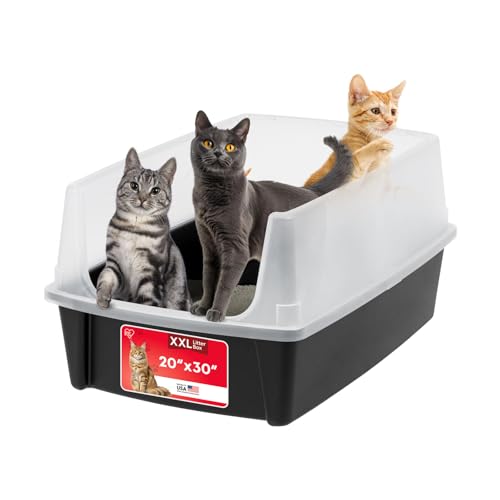


Your cat's size and age decide the box: how many you need, how big, covered or open, and whether a self-cleaning box makes sense.
How we chose: we did not test these boxes; we checked each listing's dimensions against the AAFP and Cornell guidance below, and kept only boxes sold by Amazon.com or the brand's own store and in stock on September 28, 2026.
Seven litter boxes side by side
| Box | Type | Size (L x W x H, per listing) | Entry | Sold by | Amazon price |
|---|---|---|---|---|---|
| IRIS USA XX-Large High Sided | Open, high sides | 30 x 20 x 14 in | 6.5 in curved front | Amazon.com | $39.99 (Amazon, as of Nov 12, 2026, 2:31 PM UTC)Check price |
| Amazon Basics Large High Sides | Open, high sides | 19 x 15 x 11.75 in | Lowered front | Amazon.com | $18.39 (Amazon, as of Nov 12, 2026, 2:31 PM UTC)Check price |
| Petmate Basic Open Pan, Small | Open, low | 14 x 10.5 x 3.5 in | All sides | Amazon.com | $5.99 (Amazon, as of Nov 12, 2026, 2:30 PM UTC)Check price |
| Nature's Miracle Hooded Flip Top | Hooded | 25.13 x 19.13 x 11.75 in | Front | Amazon.com | $44.49 (Amazon, as of Nov 12, 2026, 2:30 PM UTC)Check price |
| IRIS USA Large Top Entry | Top entry | 20.75 x 16.125 x 14.625 in | 9 x 10.5 in top | Amazon.com | $39.99 (Amazon, as of Nov 12, 2026, 2:30 PM UTC)Check price |
| Modkat Top-Entry | Top entry | 15.9 x 15.9 x 14.6 in | Top | Modkat | $109.99 (Amazon, as of Nov 12, 2026, 2:30 PM UTC)Check price |
| PetSafe ScoopFree Crystal Classic | Self-cleaning, open | 27.6 x 19.1 x 6.2 in (per the listing) | Open top | Amazon.com | $99.00 (Amazon, as of Nov 12, 2026, 2:31 PM UTC)Check price |
Prices are Amazon's, as of the time shown, and subject to change. Details
How many boxes, and how big
Start with the count. Cornell's Feline Health Center, in its page on house soiling, says: "Provide as many boxes as there are cats in the house, plus one." The ASPCA gives the same rule, and so does the AAFP. Two cats means three boxes, ideally not side by side: the AAFP's client handout says boxes "should be placed in at least 2 different locations."
Then size. The AAFP's Feline Behavior Guidelines say "cats prefer litter boxes that are at least 1.5 times the length of their bodies" and that "many commercial litter boxes are too small for larger cats." The same handout suggests sweater storage boxes, cement mixing tubs and small dog litter pans as alternatives. Cornell puts it more briefly: "Larger cats need bigger boxes."
To use the rule, measure your cat from nose to the base of the tail and multiply by 1.5. A cat that measures 18 inches wants a box about 27 inches long.
By that math the IRIS XX-Large (30 in) suits most adult cats, the Nature's Miracle hood (25 in) suits an average cat, and the Amazon Basics box (19 in) suits a smaller one. The Modkat Top-Entry is about 16 inches square per its listing, so it suits a smaller cat.
For the PetSafe ScoopFree, weight is the limit: PetSafe's own manual says it is "best for cats under 15 lb."
Litter depth matters too. The ASPCA says "most cats like a shallow bed of litter" and to use "one to two inches of litter rather than three to four inches." Our cat litter guide compares clay, silica, pine, wheat and tofu litters.

Covered or open?
Cornell is direct: "Most cats prefer an uncovered box that lets odors escape and allows a 360-degree view of their surroundings." The ASPCA adds that "most cats don't like box liners or lids on their boxes." A hood keeps the smell away from you, which is the point, but it also keeps it inside with the cat.
That does not make a hooded box wrong. Some cats spray high or kick litter hard, and a hood or a high back stops both.
If your cat already uses a covered box without trouble, the Nature's Miracle Hooded Flip Top has a charcoal filter and a front that flips up for scooping. If you are switching a cat from open to covered, try it next to the old box, not instead of it.
Top-entry boxes solve two different problems: tracked litter and a dog that raids the box. The IRIS Large Top Entry has a grooved lid to catch litter, and IRIS says the top entry keeps other pets such as dogs out. The Modkat Top-Entry uses its lid as a walk-off mat and swivels open for scooping.
Both ask the cat to jump in and climb out. The ASPCA warns that "boxes that have sides that are too high or have a top-side opening might make it difficult for your cat to enter or leave the box," so skip top entry for a kitten, a senior or a cat with stiff joints.
With an open or front-entry box, a litter mat where the cat steps out catches tracked litter instead.

Boxes for kittens and older cats
Cornell says "kittens and elderly cats need boxes with low sides," and the AAFP's guidelines tell owners of young kittens to "provide litter boxes with low sides for easy entry." For a kitten's first weeks, the Petmate Basic Open Pan, Small has 3.5 inch sides, and Petmate says it suits small cats or kittens.
Move up to a full-size box as the kitten grows; our new kitten checklist covers the rest of the first-day list.
For an older cat, the AAFP says more and bigger boxes, cleaned often, help prevent accidents caused by dirty boxes, "decreased ability to get to or into the box," and disorientation. It also suggests night lights for cats with failing vision.
The Amazon Basics box has a lowered front that its listing says helps older and large cats, and the IRIS XX-Large has a 6.5 inch entrance in a 14 inch wall.
A cat that suddenly stops using its box may be ill, not fussy. Cornell says "any medical condition that interferes with a cat's normal urination or defecation behavior can cause litter box problems," and the ASPCA lists urinary tract infection, interstitial cystitis and bladder stones among the causes.
If the change is sudden, or your cat strains or cries in the box, ask your vet (more on that). Clean any accidents with an enzyme product; our enzyme cleaner guide explains why.
Self-cleaning boxes: the rules makers publish
A self-cleaning box saves scooping, not judgment. The ASPCA says "many cats accept them readily," but "if you're using a self-cleaning litter box and your cat starts eliminating outside the box, try switching to a traditional type of litter box." You also lose the daily look at the clumps that tells you when something has changed, so check the app or the waste drawer.
The makers set age and weight limits because their sensors need them:
- PetSafe ScoopFree. The ScoopFree manual says: "If your kitten is under 6 months of age, leave the unit UNPLUGGED and scoop waste until kitten is 6 months old." It rakes "20 minutes after your cat leaves the litter box" and is "best for cats under 15 lb." PetSafe's setup guide repeats the 6 month rule.
- Whisker Litter-Robot 4. Whisker's FAQ says its SmartScale "will not recognize kittens that weigh less than 3 lbs (1.3 kg)," so those kittens "can use Litter-Robot 4, but not in automatic mode."
So a kitten under the maker's minimum should not use a self-cleaning box in automatic mode. Leave it switched off and scoop by hand until the kitten passes the age or weight the maker names.
The card here is the PetSafe ScoopFree Crystal Classic, sold by Amazon.com: an open, low box with a disposable crystal-litter tray and a lid for throwing the tray away, per the listing. PetSafe's Crystal Pro Legacy, which we listed before, is now sold on Amazon by a third-party seller, so it no longer gets a card. Our self-cleaning litter box guide compares the Classic with five other self-cleaning boxes.
The Classic's listing promises no scooping, cleaning or refilling for weeks, because the waste goes into the tray. We left out the Litter-Robot 4: on September 28, 2026 its Amazon listings were sold by Spreetail, not by Amazon.com or Whisker.

Refills and replacement parts
The ScoopFree Crystal Classic works only with PetSafe's disposable crystal litter trays, which are the litter and the liner in one. PetSafe's manual puts a tray's life at 20 to 30 days with one cat, 10 to 15 days with two and 7 to 10 days with three or more, and shorter in humid rooms.
If you buy a Litter-Robot 4 elsewhere, Whisker says to change its carbon filter and OdorTrap packs every 2 to 4 weeks, and the drawer liner at every emptying. Our self-cleaning litter box guide lists the bags, trays and filters for six self-cleaning boxes, with each maker's interval.
Recalls
None of these brands appears on our pet product recall page, which tracks FDA and CPSC pet recalls from 2024 onward, and a search of the CPSC recall database on September 28, 2026 found no recall of litter boxes, self-cleaning or otherwise. Check again before you buy a used self-cleaning box.
Our picks, in order
Ranked in the order we recommend them, from listings, certifications and standards. Where a price appears it is Amazon's, with the time it was read.
Large cats and multi-cat homes
IRIS USA XX-Large High Sided Cat Litter Box
From the listing · not testedBuy it for a large cat; it is the box here most likely to pass the length test.
Pros
- + 30 x 20 x 14 in with a 6.5 in curved entrance, per the listing
- + Open top; IRIS pitches it at large breeds such as Maine Coons and at multi-cat homes
- + At 30 in long, it meets the AAFP's 1.5-times rule for a cat up to 20 in long
Cons
- - At 30 in long it needs real floor space
Average cats, easy step-in
Amazon Basics Large Cat Litter Box with High Sides
From the listing · not testedBuy it for an average-size adult cat that needs a low step in.
Pros
- + 19 x 15 x 11.75 in, open top, per the listing
- + Lowered front that the listing says makes it easier for older and large cats to get in and out
- + Scoop with on-board storage
Cons
- - 19 in long, so small for a big cat by the AAFP rule
A kitten's first weeks
Petmate Basic Open Plastic Cat Litter Pan, Small
From the listing · not testedBuy it for a kitten's first weeks, then move up a size.
Pros
- + 14 x 10.5 in with 3.5 in sides, per the listing
- + Petmate says the small pan suits small cats or kittens
- + Open on all sides, so a kitten can step in anywhere
Cons
- - A kitten will outgrow it

Cats used to a covered box
Nature's Miracle Hooded Flip Top Cat Litter Box
From the listing · not testedBuy it for a cat that already uses a covered box, or sprays over open sides.
Pros
- + 25.13 x 19.13 x 11.75 in with a front entry, per the listing
- + Built-in charcoal filter and a flip-top front opening for scooping
- + At 25 in long, it fits an average cat by the AAFP's length rule
Cons
- - A hood holds odor in; Cornell says most cats prefer an uncovered box

Agile cat, dog in the house
IRIS USA Large Top Entry Cat Litter Box
From the listing · not testedBuy it for a young, agile cat in a home with a dog.
Pros
- + 20.75 x 16.125 x 14.625 in with a 9 x 10.5 in top opening, per the listing
- + Grooved lid catches litter from paws; IRIS says the top entry also keeps dogs out
- + Made in USA
Cons
- - Top entry means jumping in and out, which the ASPCA flags as hard for some cats

Keeping tracked litter down
Modkat Top-Entry Cat Litter Box
From the listing · not testedBuy it for an agile cat if tracked litter is your main complaint.
Pros
- + Top-entry lid doubles as a walk-off mat, per Modkat
- + Swivel lid for scooping; seamless full-height base
- + Reusable liner that Modkat says lasts up to 3 months
Cons
- - Same top-entry caveat as the IRIS; about 16 in square, so it suits a smaller cat

Skipping the daily scoop
PetSafe ScoopFree Crystal Classic Self-Cleaning Litter Box
From the listing · not testedBuy it for the simplest setup, if you accept PetSafe's trays for as long as you own it.
Pros
- + Disposable crystal litter tray with a lid for disposal; no scooping for weeks, per the listing
- + A rake sweeps solid waste into a covered trap 20 minutes after the cat uses the box, per PetSafe's ScoopFree manual
- + Open, low design
Cons
- - Runs only on PetSafe's crystal trays; PetSafe's manual says unplugged until a kitten is 6 months old and best for cats under 15 lb
Frequently Asked Questions
How often should I clean the litter box?
Scoop at least once a day and rinse the whole box with baking soda or unscented soap once a week, the ASPCA says. Cornell adds that litter should be changed often enough that it looks and smells dry and clean.
Where should the litter box go?
Somewhere quiet, private and away from the food bowl, per Cornell, and reachable at any hour. The ASPCA says to keep it away from the washer and dryer and from a dog's bowls, and not in a spot where the cat could feel cornered.
Is my cat spraying or missing the box?
Look at the posture. Cornell says a spraying cat stands, lifts its tail, quivers and sprays small puddles on vertical surfaces, while a cat toileting squats. Spraying is marking, a different problem from box aversion, and worth raising with your vet.
Proof
Sources
Everything this guide relies on, as linked in the text. Last checked September 28, 2026.
- vet.cornell.edu: Feline behavior problems house soiling
- ASPCA: Litter box problems
- American Association of Feline Practitioners: Feline Behavior Guidelines
- petsafe.net: ScoopFree manual
- support.petsafe.net: Setup guide
- litter-robot.com: FAQ
- U.S. Consumer Product Safety Commission: CPSC recall database
PetProofLab is a participant in the Amazon Services LLC Associates Program, an affiliate advertising program designed to provide a means for sites to earn advertising fees by advertising and linking to Amazon.com. Sizes and features are the makers' own, from their listings and manuals. This guide is for general information and is not veterinary advice.
Amazon prices and availability change often; cards with a live Amazon price show when it was last checked. As an Amazon Associate I earn from qualifying purchases.


