Senior Cat Food (2026): Kidneys and Weight Loss
Senior cat foods are adult foods: AAFCO has no senior stage. Four with the maker's AAFCO statement, why older cats lose weight, and when kidney diets matter.
Independently chosen. As an Amazon Associate I earn from qualifying purchases: if you buy through our links, we may earn a commission at no cost to you. How we research
Quick answer
A senior cat food is an adult maintenance food with an age on the bag: AAFCO has no senior life stage. A Tufts review of a published study found senior cat foods were no lower in phosphorus or sodium than adult foods, so a cat with kidney disease needs a diet your vet chooses, not a senior label. For a healthy older cat, Pro Plan AdvantEDGE Senior Support, Hill's Science Diet Adult 7+ and Adult 11+ passed AAFCO feeding tests for adult maintenance, per their makers; Royal Canin Aging 11+ is formulated for maintenance. Weigh your cat regularly: many older cats lose weight.
Our picks
- Older cats losing weightPurina Pro Plan AdvantEDGE Senior Support Dry Cat Food, Chicken, 5 lbFrom the listing · not tested


Once a cat passes 7, the food question splits in two. A healthy older cat needs an adult food with the right calories for its weight. A cat with kidney disease, or one losing weight for no clear reason, needs a vet before it needs a new bag.
How we chose: we did not feed or test these foods; we read the AAFCO statement and calorie figure for each on the maker's own site and kept foods sold by Amazon.com and in stock on September 28, 2026.
Four senior cat foods and their AAFCO statements
| Food | Life stage in the AAFCO statement | Basis | kcal per cup (maker) | Sold by | Amazon price |
|---|---|---|---|---|---|
| Pro Plan AdvantEDGE Senior Support | Maintenance of adult cats | Feeding tests | 590 | Amazon.com | $32.98 (Amazon, as of Nov 12, 2026, 11:24 PM UTC)Check price |
| Hill's Science Diet Adult 7+ | Maintenance of adult cats | Feeding tests | 490 | Amazon.com | $34.97 (Amazon, as of Nov 12, 2026, 11:23 PM UTC)Check price |
| Hill's Science Diet Adult 11+ | Maintenance of adult cats | Feeding tests | 504 | Amazon.com | $34.97 (Amazon, as of Nov 12, 2026, 11:23 PM UTC)Check price |
| Royal Canin Aging 11+ | Maintenance | Formulation | 360 | Amazon.com | $36.99 (Amazon, as of Nov 12, 2026, 11:24 PM UTC)Check price |
Prices are Amazon's, as of the time shown, and subject to change. Details
The statements come from Purina's AdvantEDGE Senior Support page, Hill's Adult 7+ page, Hill's Adult 11+ page and Royal Canin's Aging 11+ page.
"Senior" is marketing; the statement is the label
AAFCO's label guide lists four life stages a nutritional adequacy statement can name: gestation/lactation, growth, maintenance and all life stages. The 2023 AAHA Senior Care Guidelines state that AAFCO "does not currently have guidelines for senior nutrition." Every senior cat food therefore meets the same adult maintenance profile as an ordinary adult food.
The makers' age cutoffs are their own. AAHA's guidelines note that the 2021 AAHA/AAFP Feline Life Stage Guidelines and the AAFP Feline Senior Care Guidelines define senior as cats older than 10 years. Pet food labels use 7+ and 11+.
The Tufts veterinary nutritionists behind Petfoodology reviewed a study comparing 31 senior and 59 adult cat foods, run by researchers at Oregon State, Colorado State and UC Davis. "The only difference that was found between the senior diets and the adult diets was higher fiber in the senior diets." Protein, fat and minerals were no different. Foods labeled 11+ had more calories than those labeled 7+.
Tufts' conclusion is worth quoting: diets for older cats should be chosen on "the individual nutritional needs of the cat and specific nutrient levels in the food, rather than on arbitrary marketing designations that are not based on data or regulations."

Why older cats lose weight
AAHA says obesity in senior pets "is more common in dogs." Many older cats go the other way, and that changes what "senior food" should mean.
AAHA's guidelines say a cat's maintenance energy requirement falls until about age 10, "after which they start to increase," though published data are "extremely variable."
Digestion also changes: AAHA says proteins "are less digestible in 20% of cats older than 11 yr, and fats are less digestible in up to 33% of cats," and cats can lose up to 33% of their lean body mass between 10 and 15 years of age.
It concludes that "healthy senior cats may require higher-caloric-density, higher-protein diets with increased digestibility and enhanced palatability fed in smaller amounts more frequently," and that senior pets, "particularly cats, may need up to 50% more protein" to slow muscle loss.
Body condition works differently too. AAHA says a cat's ideal score "up to 6 out of 9" can be associated with longer life, and that underweight cats carry "greater morbidity and mortality risks."
Tufts notes in its study review that "many cats in their teens lose weight," so the higher calories in 11+ foods "would likely be beneficial for these cats." Fiber cuts both ways: it can help a middle-aged cat feel full, but Tufts says high fiber also lowers digestibility and may add to weight loss in elderly cats.
Weight loss in an older cat is also a symptom. The Cornell Feline Health Center lists weight loss, increased appetite, and increased thirst and urination as the most common signs of hyperthyroidism, which "mostly afflicts cats middle-aged and older."
A cat that is eating well and still getting thinner needs a vet visit before a food change. Ask your vet; this page is general information, not veterinary advice (more on that).
Kidney disease: the vet chooses the diet
Chronic kidney disease is the reason diet matters most for many older cats. Cornell says CKD is "one of the most prevalent diseases in older cats, affecting up to 40% of cats over the age of 10 and 80% of cats over the age of 15," and that early stages often show no obvious signs, which is why senior cats should be regularly monitored.
Diet is part of treatment. Cornell says therapeutic diets restricted in protein, phosphorus and sodium "may prolong life and improve quality of life in cats with CKD," and that some studies show cats with CKD eating a prescription kidney diet "live 2-3 times longer than those eating a standard commercial cat food."
Kidney diets such as Hill's Prescription Diet k/d and Royal Canin's veterinary Renal Support line exist for exactly this. They are not on this page because the choice, the timing and the monitoring belong to your vet.
What a senior label does not do is stand in for a kidney diet. In the study Tufts reviewed, senior diets "were no lower in these minerals than the adult diets," and Tufts recommends specific low-mineral over-the-counter or therapeutic veterinary diets "for cats with confirmed or suspected kidney disease, rather than a broad recommendation for a 'senior' diet."
Tufts' senior diet article adds that low phosphorus helps pets with kidney disease, but it is not known whether it prevents the disease.
Water matters with CKD as well. Cornell says maintaining hydration is "essential," recommends feeding wet forms of the therapeutic diet, and notes that "many cats prefer to drink from water fountains." Our guides to wet vs dry cat food and cat water fountains cover both.

Reading the four foods
For a cat that is losing weight or eating little: Pro Plan AdvantEDGE Senior Support lists 590 kcal per cup and Hill's Adult 11+ lists 504, both with feeding-trial statements. That fits AAHA's point that healthy senior cats may need higher-calorie, higher-protein food. Rule out disease with your vet first.
For a healthy cat at a good weight: Hill's Adult 7+ (490 kcal per cup) or Royal Canin Aging 11+ (360 kcal per cup). The Royal Canin food puts the fewest calories in each cup, so a cat will eat a larger volume for the same energy. Neither choice is wrong. What matters is measuring the portion against the bag's feeding guide and checking your cat's weight.
If your cat prefers wet food: Fancy Feast sells a Senior 7+ pâté line, and Purina's page for Fancy Feast Senior Classic Pate Chicken describes it for senior cats, but we could not find the AAFCO statement printed on that page, so it did not get a card.
Hill's also makes Adult 7+ wet foods; on its Adult 7+ Savory Chicken Entrée page, Hill's says feeding tests substantiate it for maintenance of adult cats. Read the statement on any can before you buy; our wet cat food guide shows where to find it and how to spot a topper that is not a complete meal.
Feeding smaller meals more often is part of AAHA's advice for healthy senior cats. An automatic feeder can split the day's measured portion into several small meals.

How to change an older cat's food
Slowly. Tufts' advice on switching foods is to mix in more of the new food over at least a week. That matters more for cats than for dogs: Cornell warns that cats with CKD "that go without food for relatively short periods of time may develop significant health problems," so a cat that refuses a new food should go back to the old one while you call your vet.
Recalls
We checked every brand here against our pet product recall page, which tracks FDA and CPSC pet recalls from January 2024 to September 28, 2026. None of these Purina Pro Plan, Hill's Science Diet, Royal Canin or Fancy Feast foods appears on it.
Related: Pro Plan vs Science Diet comparison, senior dog food guide, best kitten food guide.
Our picks, in order
Ranked in the order we recommend them, from listings, certifications and standards. Where a price appears it is Amazon's, with the time it was read.
Head to head: Purina Pro Plan vs Hill's Science Diet (2026)Older cats losing weight
Purina Pro Plan AdvantEDGE Senior Support Dry Cat Food, Chicken, 5 lb
From the listing · not testedBuy it for an older cat losing weight or eating less, once your vet agrees.
Pros
- + Purina's statement: "Animal feeding tests using AAFCO procedures substantiate that Pro Plan AdvantEDGE Senior Support+ Adult 7+ Chicken & Rice Formula provides complete and balanced nutrition for maintenance of adult cats."
- + Purina lists 590 kcal per cup, the most energy-dense of the four here
- + High protein with probiotics, chicken as the first ingredient, per the listing
Cons
- - So calorie-dense that a cat already at a good weight needs a small, measured portion
Healthy cats from age 7
Hill's Science Diet Adult 7+ Dry Cat Food, 7 lb
From the listing · not testedBuy it for a healthy cat at a good weight entering its senior years.
Pros
- + Hill's statement: "Animal feeding tests using AAFCO procedures substantiate that Hill's Science Diet Adult 7+ Chicken Recipe Cat Food provides complete and balanced nutrition for maintenance of adult cats"
- + Hill's recommends it for cats 7 years and older and lists 490 kcal per cup
- + Made in the USA, per the listing
Cons
- - The Amazon title does not name the recipe; check that the bag says Chicken Recipe
Cats in their teens
Hill's Science Diet Adult 11+ Dry Cat Food, 7 lb
From the listing · not testedBuy it for a cat in its teens that needs a few more calories per cup.
Pros
- + Hill's statement: "Animal feeding tests using AAFCO procedures substantiate that Hill's Science Diet Adult 11+ Chicken Recipe Cat Food provides complete and balanced nutrition for maintenance of adult cats"
- + Hill's recommends it for cats 11 years and older and lists 504 kcal per cup
- + Made for the teenage years, when Tufts says many cats lose weight
Cons
- - The Amazon title says "Senior 11+" while Hill's page names it Adult 11+ Chicken Recipe; check the bag
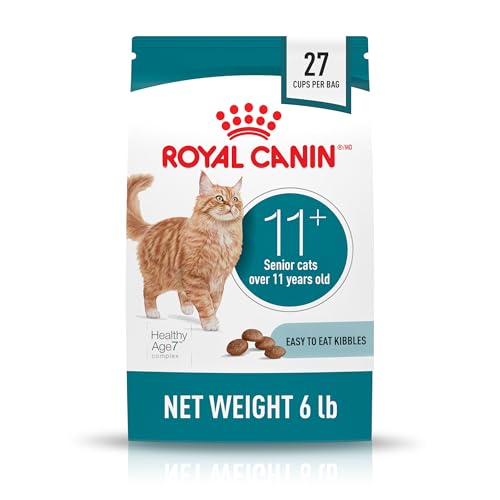
Small, easy-to-chew kibble
Royal Canin Aging 11+ Dry Cat Food, 6 lb
From the listing · not testedBuy it for an older cat that needs an easy-to-chew kibble and no extra calories.
Pros
- + Royal Canin's statement: "ROYAL CANIN AGING 11+ is formulated to meet the nutritional levels established by the AAFCO Cat Food Nutrient Profiles for maintenance."
- + For cats over 11 years, per Royal Canin; 360 kcal per cup
- + Easy-to-chew kibble, per the listing
Cons
- - Met by formulation, not a feeding trial
Frequently Asked Questions
Does a healthy older cat need a senior food at all?
No. Tufts' senior diet article says that if an older cat is healthy, in good body condition and eating a good balanced diet, "there is no reason to change foods."
Should an older cat eat less protein?
Not by default. Tufts warns that lower-protein diets for older dogs and cats "may have negative effects by contributing to muscle loss." Protein limits belong to a vet-managed kidney diet, not a senior label.
Can a blood test catch kidney disease early?
Earlier than it used to. Cornell says SDMA, one of the kidney values on a blood panel, rises when about 40% of kidney function is lost, which can mean an earlier diagnosis. Age is the only known risk factor, so ask for it at senior checkups.
Proof
Sources
Everything this guide relies on, as linked in the text. Last checked September 28, 2026.
- shop.purina.com: Purina's AdvantEDGE Senior Support page
- hillspet.com: Hill's Adult 7+ page
- hillspet.com: Hill's Adult 11+ page
- royalcanin.com: Royal Canin's Aging 11+ page
- Association of American Feed Control Officials: AAFCO's label guide
- American Animal Hospital Association: 2023 AAHA Senior Care Guidelines
- American Animal Hospital Association: 2021 AAHA/AAFP Feline Life Stage Guidelines and the AAFP Feline Senior Care Guidelines
- sites.tufts.edu: Comparing senior and adult cat diets
- vet.cornell.edu: Cornell Feline Health Center
- vet.cornell.edu: Chronic kidney disease
- hillspet.com: Prescription Diet k/d
- royalcanin.com: Renal Support
- sites.tufts.edu: Senior diet article
- purina.com: Fancy Feast Senior Classic Pate Chicken
- hillspet.com: Adult 7+ Savory Chicken Entrée page
- sites.tufts.edu: Switching foods
PetProofLab is a participant in the Amazon Services LLC Associates Program, an affiliate advertising program designed to provide a means for sites to earn advertising fees by advertising and linking to Amazon.com. AAFCO statements, calorie figures and age ranges are the makers' own, from their websites and listings. This guide is general information and is not veterinary advice.
Amazon prices and availability change often; cards with a live Amazon price show when it was last checked. As an Amazon Associate I earn from qualifying purchases.